In practice, the profiles that benefit most are children and teenagers with progressing myopia within a myopia-control strategy, athletes who need sharp vision without glasses (swimming, martial arts, cycling, football), professionals who spend long hours in front of screens and find daytime contacts uncomfortable, and active adults in Barcelona looking to reduce their dependence on glasses during the day.
Who is Ortho-K for?
Ortho-K can be an interesting solution for very different profiles, but not everyone is a candidate. Suitability depends on prescription, corneal shape, ocular health and hygiene and follow-up habits.

Who might find it interesting?
Children with progressing myopia
Teenagers who play sports
Adults who want to reduce glasses use during the day
People who don't tolerate daytime contact lenses well
Families concerned about myopia progression
People looking for a non-surgical alternative
Not every patient is a candidate. Prescription, corneal shape, ocular health and usage habits are important factors.
Public-service candidates and jobs with visual requirements
Mossos d'Esquadra, Bombers and Guardia Urbana
If you're preparing exams for Mossos, Bombers or Guardia Urbana, Ortho-K can help you meet the uncorrected visual acuity requirements during the tests.
See the public-exams page →Ortho-K vs laser surgery: which one fits your case?
Both options aim to reduce dependence on glasses, but they start from very different premises: Ortho-K is non-surgical and reversible; laser refractive surgery (LASIK, PRK, SMILE) reshapes the cornea permanently. This comparison is informational and does not replace a professional assessment.
| Feature | Ortho-K | Laser surgery |
|---|---|---|
| Type of procedure | Non-invasive, optical | Surgical |
| Reversibility | Yes, within a few days of stopping lens wear | No, reshapes the cornea permanently |
| Recommended age | From around 6-8 years old | Adults from 18-21 with a stable prescription |
| Treatable prescription | Myopia up to ~-5 D and low astigmatism | Wider range depending on technique |
| Childhood myopia control | Yes, with evidence | Not applicable |
| Adaptation time | 1-4 weeks to stabilise vision | Fast visual recovery, permanent effect |
| Maintenance | Nightly wear and strict hygiene | None after surgery, plus follow-ups |
| Main risks | Infection if hygiene is poor; reversible on discontinuation | Surgical risks, dryness, night halos |
| If prescription changes | Lens design can be readjusted | May require a surgical enhancement |
When each one makes sense
Ortho-K is a good fit if…
You are a minor or your prescription may still change, you play sports or your job requires uncorrected acuity (public exams, active lifestyle), you do not want surgery, or you want a reversible option you can stop at any time.
Laser surgery is a good fit if…
You are an adult with a prescription that has been stable for at least a year, you have no corneal contraindications after the preoperative study, and you accept a permanent procedure as a long-term solution.
This comparison is for educational purposes. The decision should be made with a professional after a full visual and corneal evaluation.
+Is Ortho-K reversible while laser surgery is not?
Yes. The optical effect of Ortho-K depends on continued lens wear: stop wearing them and the cornea returns to its original shape within a few days. Laser refractive surgery permanently reshapes the corneal tissue.
+At what age can I have laser surgery compared with starting Ortho-K?
Laser surgery is usually considered from age 18-21 and only with a stable prescription for at least a year. Ortho-K can be considered from paediatric ages (around 6-8) and is the only one of the two options applicable to childhood myopia control.
+Which is better for childhood myopia control?
Refractive surgery is not used to slow myopia progression in children. Ortho-K, together with other myopia-control strategies, does have evidence for slowing axial elongation during growth.
Who benefits (and who doesn't)
It is also an option for people with mild dry eye or intolerance to soft contacts, since the lenses are worn only during sleep and the eyes rest open without any lens during the day.
It is not suitable for people with active eye infections, significant corneal disorders (keratoconus, dystrophies), severe dry eye, poor hygiene, or no ability to attend follow-up visits. Nor for prescriptions outside the usual range without careful assessment.
The only way to know whether Ortho-K is right for you is a complete optometric assessment that includes corneal topography.
Keep reading
Myopia control
Myopia control in children and teens in Barcelona with Ortho-K: strategies, how overnight lenses work and professional follow-up.
→Athletes
Ortho-K for athletes in Barcelona: clear daytime vision without glasses or contacts for swimming, cycling, football and contact sports.
→Ortho-K cost
Indicative Ortho-K cost in Barcelona: €200 assessment, €290-360 per lens, with follow-up reviews and adjustments included.
→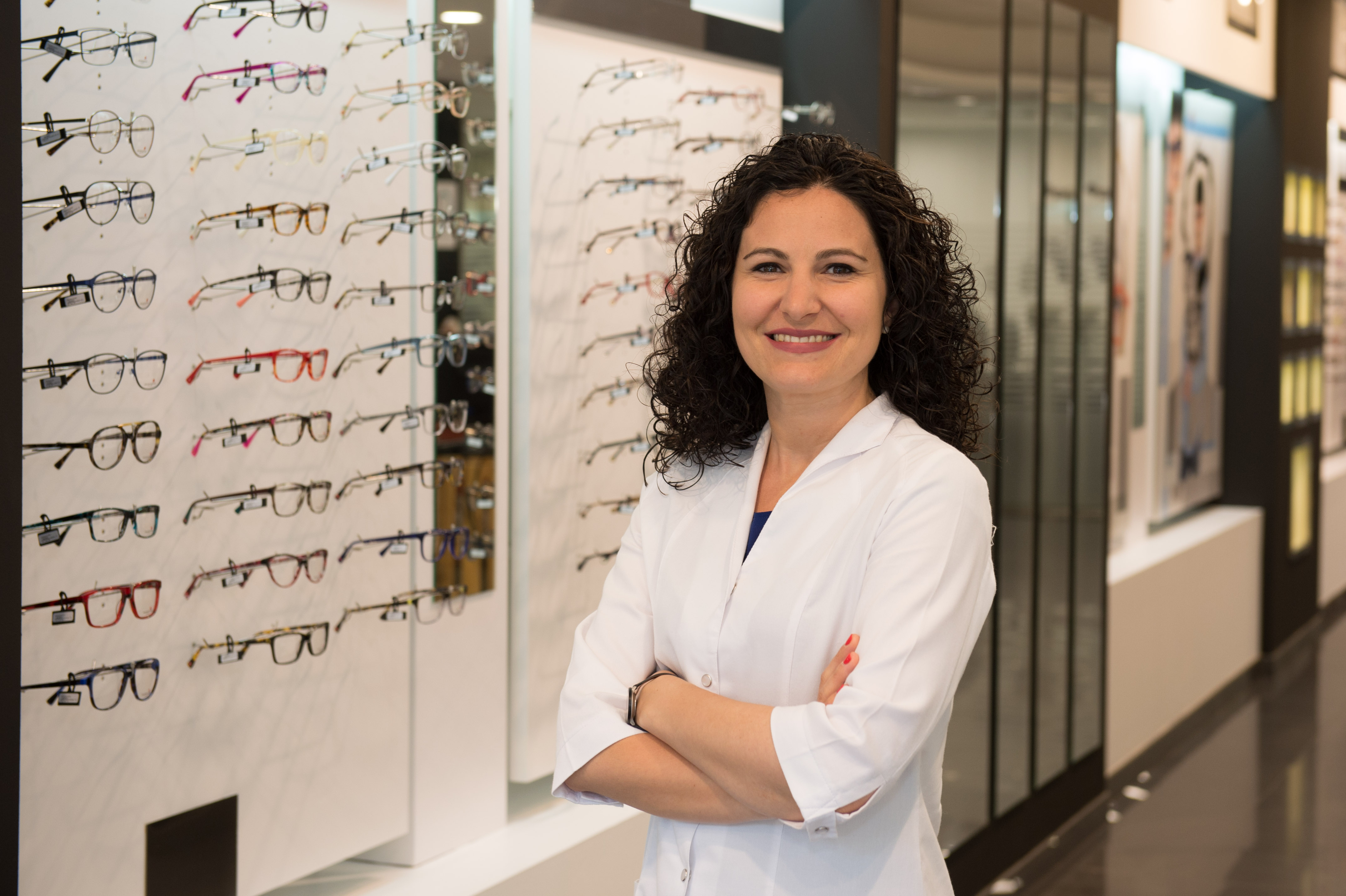
Content reviewed by Elena Sentís, optometrist (registration no. 18568) and technical director of Looptica Poblenou. Specialist in advanced contact-lens fitting, Ortho-K and myopia control.
Last reviewed: July 2026About Elena Sentís →